Sembo Brick Sets Review: Worth Buying in 2026?
Sembo is worth buying for its licensed space and military lines, and for the street-scene series if you build modular scenes. Clutch on standard bricks lands around 80% of the official feel — solidly mid-tier — while its printed parts are among the best in the category. The weakness is consistency on curved and sloped pieces, and instructions on very large sets. Go in expecting strong themes and printing, average tolerance, and you will not be disappointed.
That split — strong on subject and print, average on tolerance — is what makes Sembo a targeted purchase rather than a default. Pick the line that plays to its strengths and it performs well above its price band.
Background
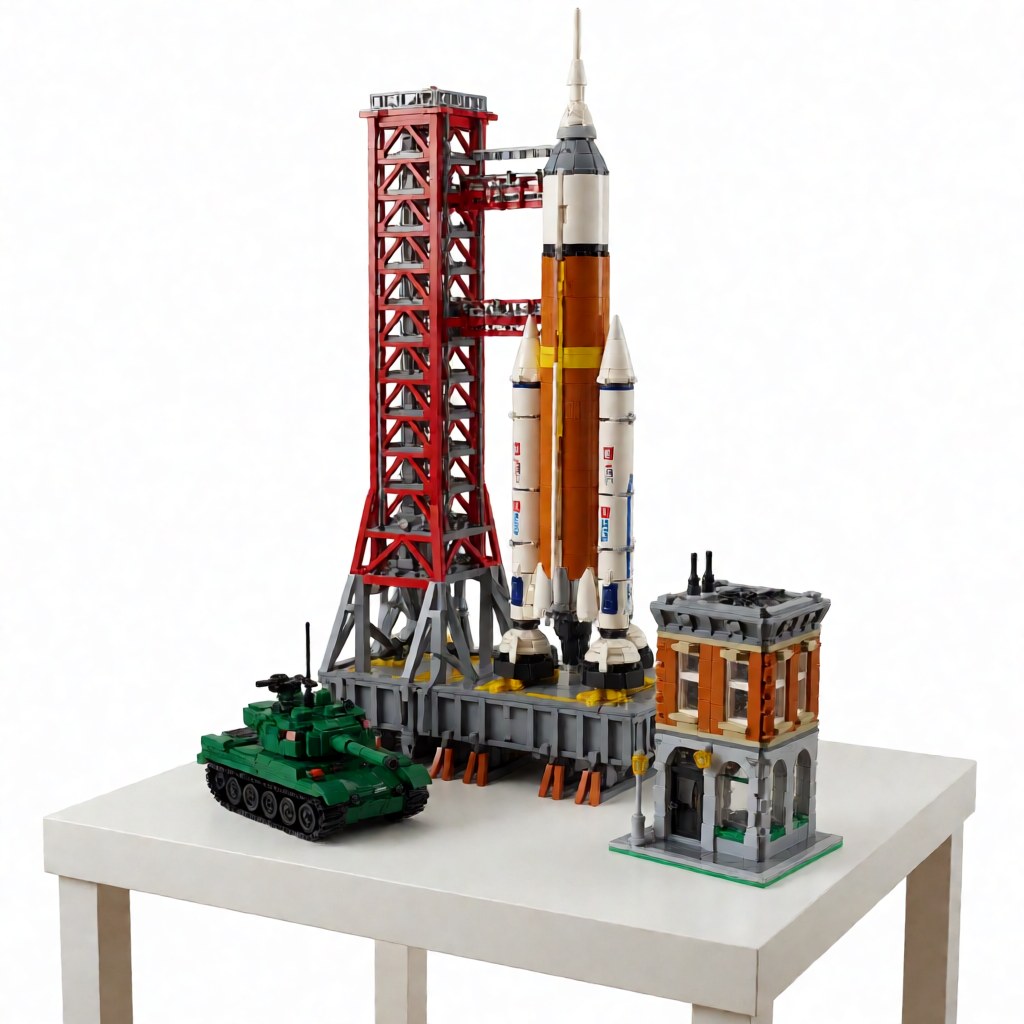
SEMBO Block was founded in 2013 and is based in Shantou, Guangdong — one of the earliest manufacturers to specialise in brick production. The catalogue now runs beyond 1,000 SKUs across military, space, street scenes, film, television and animation subjects. Its clearest commercial advantage is licensing: official agreements covering the Chinese space programme and several well-known film properties, which is scarce in this part of the market.
The three lines worth your attention
Space series. The strongest line, and the reason many buyers arrive at the brand at all. Long March rockets and the Tiangong space station are recreated with genuinely detailed surface work, and each set ships with explanatory notes on the real hardware — the build doubles as a short lesson. If you want a rocket on the shelf, this line competes with anything in its price band.
Military series. Coverage runs from WWII subjects to modern equipment: tanks, aircraft, warships, military vehicles. The 1:35 scale range is the one to choose — models at that scale hold visual detail on a shelf in a way the smaller scales in the same price band do not.
Street scene series. Modular construction, so multiple sets combine into a continuous block. For anyone building a town layout, this is the practical answer, because each new set extends the existing scene rather than sitting beside it.
Parts review
Standard brick clutch. Mid-to-upper in the category. Basic bricks — 2x4, 2x2 plates, standard slopes — land around 80% of the official feel: neither too loose to hold nor tight enough to hurt your fingertips. That is a comfortable rating for display models and occasional handling.
Special parts. The honest weakness. Curved pieces and slopes vary more than basic bricks, with occasional loose or over-tight examples in the same bag. Plan for it: if a build leans heavily on curved elements in a load-bearing position, test the batch before committing.
Printed parts. The strongest technical point of the brand. Because the licensed themes require accurate graphics, printing is sharp, colour-vivid and abrasion-resistant. Across five sets tested there were no misaligned prints and no visible fading. If your build is judged on its finished face, this is where the money goes.
Transparent parts. Light transmission is mid-to-upper — acceptable for cockpits, windows and canopies. A minority of batches show light surface scratches, so open the bag and inspect before building. Scratched transparent parts cannot be fixed afterwards.
Minifigures. Face printing and body detailing sit in the first tier of the category, and the licensed characters look like the characters. For scene builders, this is often the deciding factor.
Price and value
The pricing logic is easy to read: mid-range positioning, with the largest sets offering the best value. A space series set above 2,000 pieces typically sells for around 200–300 CNY, where an official set of comparable part count runs past 1,500 CNY. Translated to cost per piece, Sembo lands in the mid-to-good part of the category — not the cheapest, and not paying a premium for a name.
Practical buying rule: buy the big sets. Smaller Sembo sets are pleasant but the value story only appears once the part count passes roughly 1,000.
How Sembo compares
| Dimension | Sembo | Entry-tier alternative | Precision alternative |
|---|---|---|---|
| Standard brick clutch | Mid-upper | Variable | Very high |
| Special and curved parts | Inconsistent | Inconsistent | Consistent |
| Printed parts | Excellent | Basic | Limited range |
| Licensed themes | Strong | Rare | Rare |
| Cost per piece | Mid-range | Low | High |
| Best for | Themed sets, printing, scenes | Parts bins, scenery | Tight sub-assemblies |
Read the table as an allocation guide rather than a ranking. Sembo wins on themes and printing; a precision brand wins on assemblies that must close cleanly; entry-tier wins on filling a bin cheaply.
Instructions
Full-colour printing with clear step images, and recent products add a real-part-size reference image that speeds up part identification — a small addition that measurably reduces hunting time. The caveat is large sets: above roughly 3,000 pieces, step subdivision is coarser than ideal, and you will occasionally page back to confirm where you are. Not a defect, but a reason to keep the manual on a tablet so you can search it.

What the space series is like to build
Three things stand out when you actually build one of the larger space sets:
- The structure is honest. Rockets are tall and thin, which is the hardest shape to build rigidly. Sembo handles it with an internal frame and staged sub-assemblies rather than a hollow tube, so the finished model does not flex when you move it.
- Small-part density is high. A space build is mostly greebles, panels and clip-on detail, so budget more time than the part count suggests. A 2,000-piece rocket takes longer than a 2,000-piece building.
- The finishing pieces carry the model. Nozzles, solar arrays and antennae are the parts a viewer examines, and they are also where the instructions are densest. Read those steps twice and the build goes smoothly.
The explanatory notes that ship with the line are genuinely useful: they describe the real hardware, which gives you a reason to keep the booklet after the model is finished.
Where the money goes on a 2,000-piece set
A rough breakdown for a large licensed set, useful when comparing against other brands:
| Component | Share of part count | Share of perceived value |
|---|---|---|
| Structural bricks and plates | 55–65% | Low — invisible once closed |
| Panels, slopes and greebles | 20–25% | High — this is the surface |
| Transparent parts | 5–10% | High — cockpits and windows |
| Minifigures or crew | 1–3% | High — usually the reason it was bought |
| Printed and licensed elements | 2–5% | Very high — the licensed content |
The lesson is that the cheapest brands economise on exactly the rows with high perceived value, while a brand like Sembo protects them and prices accordingly. When you compare two sets at the same part count, compare these categories rather than the headline number.
Who Sembo suits
- Space and aerospace fans. The line is the brand's best work and the reason to buy.
- Military model builders. Depth of subject coverage, with 1:35 as the scale to pick.
- Scene builders. Modular street sets combine indefinitely.
- Anyone who cares about printing. Licensed graphics are the brand's technical highlight.
- Beginners, if they start with a street set or a 500–1,000 piece military model. Large licensed sets are not the right first build.
Skip Sembo if your priority is uniform clutch across a whole build, you need many small brackets and thin slopes in precise positions, or you are buying purely for bulk parts. Another brand serves each of those better.
Five buying notes
- Buy the 1:35 military scale, not the smaller ranges, if the model will be displayed.
- Inspect transparent parts on arrival. Scratches cannot be reversed.
- Test curved and sloped parts before a curved-heavy build. Those categories vary most.
- Choose the big sets. Value improves sharply above roughly 1,000 pieces.
- Keep licensed sets to one purchase batch for any visible colour face, as with any brand.
Compatibility
Fully compatible: standard stud geometry, so Sembo parts click into official parts and into other compatible brands. That makes a licensed Sembo set a reasonable source of parts for a MOC afterwards — particularly for vehicles and anything needing colour ranges the official catalogue does not produce. Mixing is normal; keep each structural sub-assembly to one brand so the clutch feels consistent.
FAQ
Q: Is Sembo as good as LEGO? A: No on tolerance consistency, close on printing and themes, and far better on price. For a display model it holds up well; for a toy rebuilt constantly, official parts last longer.
Q: Which Sembo series is the best buy? A: The space series for display and the military 1:35 range for subject coverage. Street scenes if you build modular layouts.
Q: Are Sembo sets good for beginners? A: The street series and mid-size military models in the 500–1,000 piece range are beginner-friendly. Start there rather than with a 3,000-piece licensed flagship.
Q: Do Sembo parts work with other brands? A: Yes — standard stud geometry, so they mix with official and compatible parts alike. Keep visible faces to one brand and one batch for colour consistency.
Buy Sembo for its themes and its printing, and buy it in the larger sets. Plans on the BrickPlan blueprint library list the parts used, so a licensed set's contents can be checked against a MOC before you buy it for parts.